
Editor’s Note: This could be the most critical investing broadcast you’ll see all year. Renowned forecaster Porter Stansberry and tech insider Jeff Brown expose a government-backed campaign to channel trillions of dollars into just a handful of specialized companies.
This isn’t just a new market megatrend, says Porter, but a matter of pressing national security for our country. Get the details here, or keep reading to get the details from the man himself…
There’s no time for niceties…
If you have any money in the stock market, savings in the bank… and especially if you are responsible for your family’s wealth… you really need to hear me out, right now.
Fair warning: when you discover what’s going on, you’ll wish it wasn’t true.
But, as the saying goes… if wishes were horses, beggars would ride.
Wishes can’t stop the unstoppable. Wishes can’t change reality. And every time I’ve exposed that reality before, I’ve been met with resistance. Even ridicule.
That’s what happened when I predicted the fall of Fannie Mae and Freddie Mac, the bankruptcy of General Motors, the loss of America’s triple-A credit rating… the list goes on and on.
But I don’t let my emotions blind me to reality. No matter how difficult the truth… no matter how uncomfortable the fact… I follow my research to its logical conclusion.
You should too.
But I know most of you won’t – or can’t.
What I’ve discovered took months of investigation… and years of watching this moment build in the background of everyday life.
A powerful force — one almost no one fully understands — is on the verge of tearing through American life and wealth with brutal efficiency.
It won’t be fair. It won’t be gradual. And it won’t spare the unprepared. Hundreds of millions will feel the impact. Some could be devastated. A few others will come out far richer.
Which side you end up on may come down to one thing: how fast you act.
My job is simple: to make sure you land on the right side of what’s coming.
This force, described by Elon Musk as “the most likely cause of World War 3,” demands a response. And it’s getting one.
It’s the reason Trump has been raising trillions of dollars from the Middle East…
The reason he forced Zelensky to hand over rights to half of Ukraine’s enormous mineral deposits…
It’s the reason Apple is spending $500 billion to bring their factories back to U.S. soil…
It’s even behind the President’s strange obsession with Greenland.
The threat of this force looms so large that Trump has privately declared it a national emergency… mobilizing public and private capital on a scale we haven’t seen since the Second World War.
In fact, strange as this may sound, what’s unfolding eerily resembles America’s transition to a total war state, 85 years ago.
Back then, key industrial assets were “drafted” to support the war effort. Boeing, GM, Ford, and Caterpillar were called on to produce tanks, fighter planes, and radar.
Today, the President has recruited the likes of Apple’s Tim Cook, Amazon’s Jeff Bezos, Mark Zuckerberg, and OpenAI’s Sam Altman… to tap their vast resources for his own undeclared national emergency.
Why has he called upon the world’s largest companies and wealthiest men?
As you’ll see, trillions of dollars are rapidly being directed into a concentrated set of companies closely connected to this national emergency.
In this special broadcast, Jeff Brown and I will reveal what this national emergency is and how Trump and his team are reordering the entire economy to prepare for it.
More importantly, we’ll name the two companies most likely to profit.
This new emergency could determine who retires rich — and who gets wiped out, as it forces an epic rotation of capital from one side of the market to the other.
You still have time to prepare – but not much. In a matter of days, an expected announcement from Trump could send capital flooding into the companies we share in the broadcast.
That’s why we’re urging you to watch today.

Good investing,
Porter Stansberry
Is CoreWeave Stock a Buy Despite Insider Selling?
Written by Thomas Hughes. Published 10/27/2025.

Key Points
- CoreWeave insiders are selling shares, but investors should think twice; AI demand is robust, fueling a healthy revenue growth and profitability outlook.
- Analysts and institutions are buying this stock, providing a solid support base in Q4.
- The forecast for Q3 results is likely to be low, setting the company up for outperformance and a catalyst for higher share prices.
CoreWeave (NASDAQ: CRWV) insiders are selling shares, but investors should think twice before closing positions or shorting the stock. While there are reasons for caution, demand for AI-centric data center computing and NVIDIA (NASDAQ: NVDA) GPU-as-a-service remains enormous, supporting a strong growth and profitability outlook.
Consensus figures as of late October suggest the company’s revenue will grow at a high-double-digit compound annual rate for at least the next five years; profitability is expected by late 2026/early 2027, with earnings expanding robustly thereafter.
Nvidia x 1,000,000 (Ad)
Nvidia’s latest AI chip is a $25,000 powerhouse — with 80 billion transistors and the ability to perform 60 trillion calculations per second. Elon Musk and Nvidia’s Jensen Huang are now teaming up to deploy one million of these chips inside what could become the most advanced AI machine on the planet.
But according to James Altucher, the real opportunity isn’t in Tesla or Nvidia. He’s uncovered a little-known company that Musk, Nvidia, and even 98% of the Fortune 500 already rely on to make AI 2.0 possible. Nvidia’s CEO has even called this company “essential” to their expansion.
In that scenario, CoreWeave trades at low-teens multiples of forward estimates — which may be conservative. The company's growth trajectory supports the current price action and implies potential for a roughly 100% gain over the next few years, alongside a probable analyst upgrade cycle.
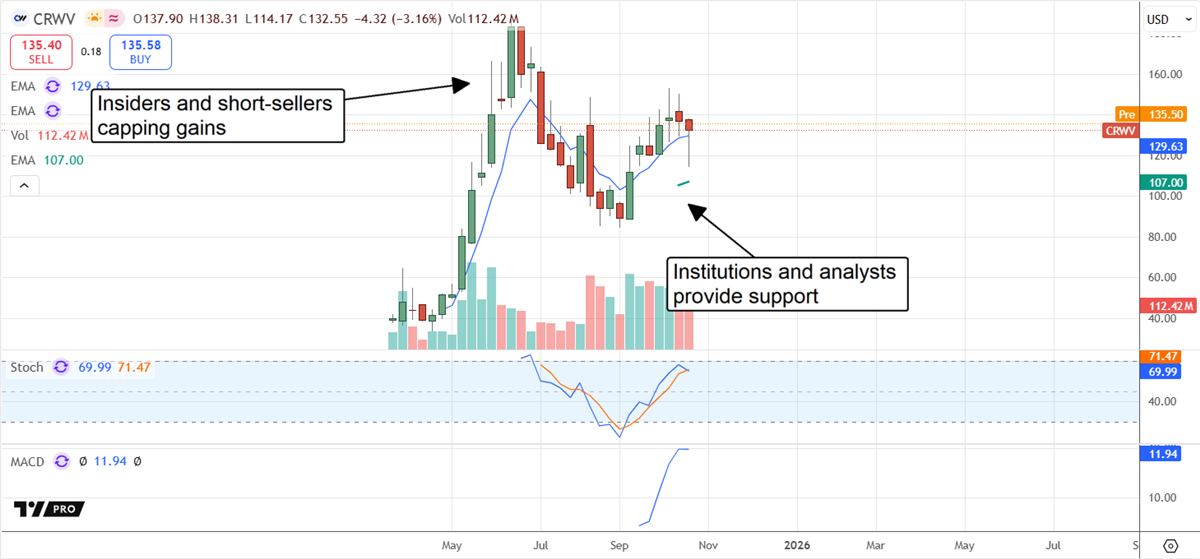
The trends in late October align with a rising share price, including increasing analyst coverage, firmer sentiment (consensus is pegged at Moderate Buy), and a rising price target. The consensus has lagged the late-October price action but still provides market support as it trends higher, having risen about 50% in the prior 90 days. The high-end range points to $200, a fresh all-time high and nearly a 50% stock move from current levels.
Institutional activity also supports an outlook for higher share prices. Institutions bought heavily in Q3, at a pace of more than $2 bought for every $1 sold, and carried that bullish trend into Q4. In the first few weeks of the quarter roughly $250 million was bought versus less than $3 million sold, bringing the group's total exposure to nearly 50% (excluding major shareholders and insiders).
CoreWeave Insiders Sell Shares as Lock-Up Expires
CoreWeave insiders — including the CEO, CFO, CSO, CDO, GC, SVP, founders and directors — have sold shares since March. Insiders have only sold since the IPO; there have been no insider buys, but investors shouldn’t overreact. Most sales align with prearranged trading plans executed to take advantage of the expiring lock-up, and Magnetar Financial, LLC accounts for the bulk of those sales.
Magnetar Financial is an early investor in the business. It is a multi-strategy alternative asset manager that first gained exposure by extending a loan that later evolved into a significant equity position. With shares trading roughly 350% above the IPO price, taking some profits was prudent.
The key takeaway: insiders still own about 25% of the company, providing a meaningful support base. The risk is that insider selling could continue in coming quarters, keeping volatility elevated.
Short Interest Is a Risk for CoreWeave Investors
CoreWeave’s short interest represents a near-term threat. Short interest has risen steadily over the past two months, reaching more than 10% in early October. While 10% is not insurmountable, it could climb further, and the combination of shorting pressure and insider selling increases downside risk.
Volatility is likely to remain high, and there is potential for sizable price corrections until some shorts cover. Important technical support levels to watch are near $130, $120 and $100.
Price action reflects this volatility: the stock has corrected more than 50% from its peak, though it posted a strong rebound in October amid analyst activity.
The next visible catalyst is the Q3 earnings release, scheduled for mid-November. Analysts currently forecast high-single-digit sequential revenue growth but have set a low bar after recent downward revisions.
Assuming CoreWeave reports results in line with other AI-centric businesses — or better — the likely outcome is meaningful outperformance and favorable forward guidance.
